AI agents and PCBs
An agent that can edit a board is not one that can prove it.
Coding agents can already drive KiCad. Nihil gives yours the other half: a simulator, a digital twin and four gates that decide, so the verdict comes from the engine and never from the agent’s word. Bring Claude Code, Codex, Gemini, Antigravity, OpenRouter or a local model.
34tools on the nihil MCP server
6agents and model routes you can launch from the terminal
4gates the agent cannot talk its way past
0models hosted, tokens resold
What already exists
There is a growing set of ways to point an agent at KiCad. Claude Code can design a PCB in KiCad through an MCP server, as JLCPCB’s walkthrough shows, and that same walkthrough is clear that the result still needs engineering verification. kicad-happy packages Claude Code and Codex skills that read schematics and layouts and review them. Academic work on agentic schematic generation aims for output that hardware-literate people check, not unchecked final designs.
The pattern in all of them: agents are good at the repetitive parts (setup, routing, rule checks) and weak at knowing whether the board works. Nihil is built around that second half.
What your agent gets
One MCP server, nihil, with 34 tools. Nihil passes it to the agent automatically when you launch Claude Code from the terminal’s + menu, a launch profile or a card. Any other agent can use the same server from a plain shell.
| Layer | What it is |
|---|---|
| The pipeline | The 14-step PCB loop and its four gates (steps 2, 5, 12 and 13), with the method’s rules served one piece at a time. |
| The engine | The circuit simulator and the twin, co-simulation sessions, firmware hosted in the loop, rigs. |
| The records | Decisions, questions, citations, the bench register, notes with call signs, history. |
| The jobs | Every run is a job with a machine slot, a log and an exit class. Headless runs, swarms and schedules use the same path. |
| The work board | Lanes, cards, boards and an inbox, written as the agent works. |
| Your window | The agent opens things for you and points at parts, nets, file lines and records, and it knows what you are looking at. |
A run, end to end
On the demo project the agent proves the ldo_breakout board on its power_up scenario:
- It starts a simulation job with
nihil sim run. The job takes a slot, runs at below-normal priority with a hang detector, and shows in the Jobs panel. - It polls the job for its state, exit class and the tail of the log.
- The scenario’s own
acceptlines decide it:accept min(+3V3) >= 3.20 after 0.005andaccept trips(F1) == 0. Both held, so the verdict is nihil obstat. - Had one failed, the agent reads which line broke and by how much, proposes the fix, asks you through the desk when it is your call, and runs it again.
The gate decides, never the agent’s word.
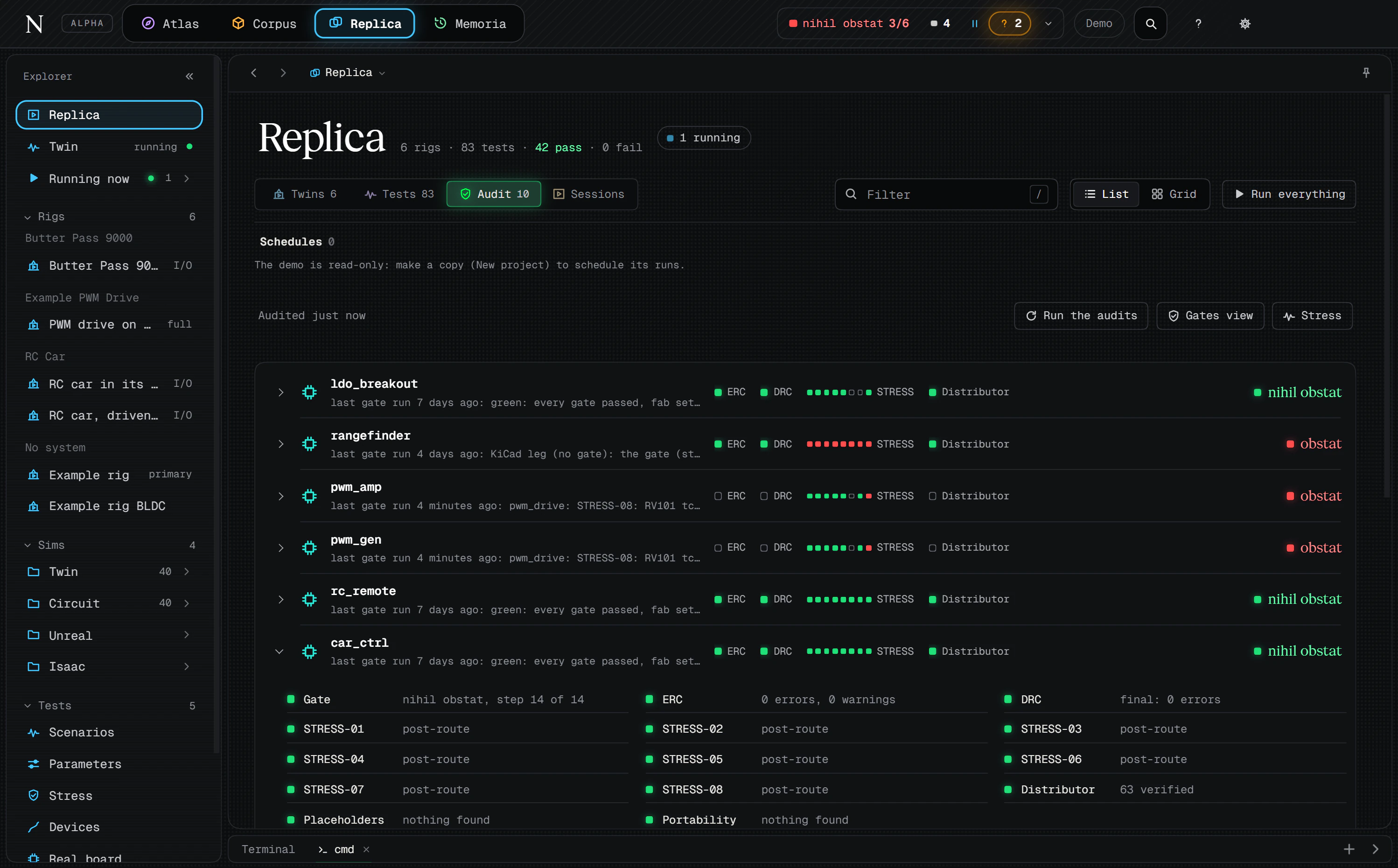
car_ctrl passed at step 14 of 14. pwm_amp reads obstat: its system fails STRESS-08, and its ERC, DRC and distributor checks have not run. A check that has not run is not a pass.Bring a board you already have
A KiCad project imports directly: drop it on the window and Nihil copies it untouched, reads each board through KiCad’s own Python and writes its declaration. For everything else (Altium, Eagle, a PDF of a schematic, a photo of a drawing), your agent writes the port. Whatever it cannot read with confidence becomes a question for you, not a guess.
A layout does not carry its physics, so the agent then declares the models, the net limits and the scenarios. Until it does, the circuit gate skips and says so.
Your agent, your plan, your bill
Nihil takes the coding agent you already run in a terminal and hands it a lab. It hosts no model, resells no tokens and marks up no compute, so you pay your provider directly and nothing in your setup changes: your plan, your terminal, your git. The same pipeline runs whether you pair with the agent on every decision or hand it the whole job.
Where it is honest to be careful
- A local model can be rough; it depends on your machine.
- An agent can write a wrong scenario. The gates judge the scenarios you have, so review the
acceptlines the way you would review a test. - Fab-ready files mean the four gates are clean, not that the design is perfect. Parts with datasheet constants only a bench can settle are listed as BENCH rows.
See it run on a real board.
The demo project is an RC car, its two boards, its twin and every gate’s record, in the real app, read-only, in a tab. The desktop app is in invite-only alpha for Windows, macOS and Linux.